Menu


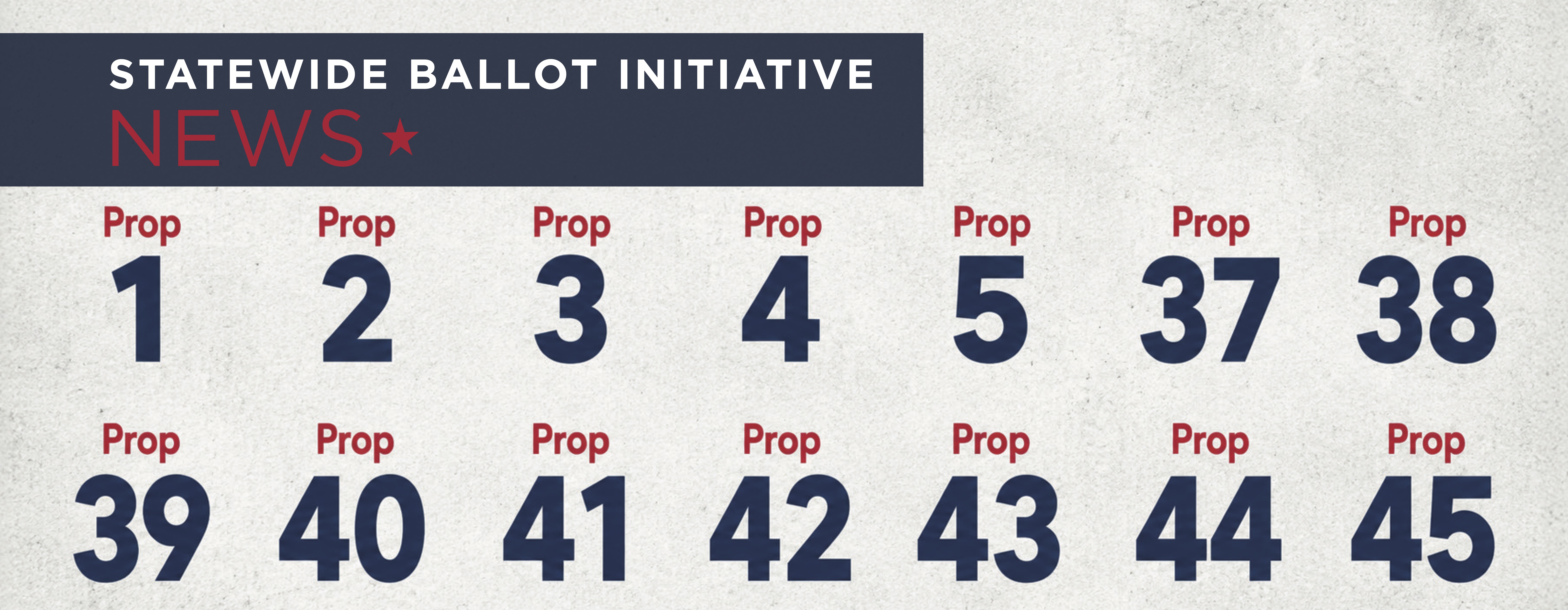
The time has finally come, and the November 2026 ballot is officially set.
What many expected to be a slow cycle for statewide ballot measures last fall, with 14 measures qualifying, the landscape exploded into the most California voters have seen on the ballot since 2016.
Introducing the November 2026 Ballot
Prop 1 – $11.25 Billion Veterans and Affordable Housing Bond
Authorizes $10 billion in state general obligation bonds to finance affordable rental housing and homeownership programs and $1.25 billion in revenue bonds for the CalVet Home Loan Program.
Prop 2 – State Rainy Day Fund Increase
Raises the maximum balance the state can hold in the Budget Stabilization Account from 10% to 20% of General Fund tax revenues and exempts reserve deposits from the state’s constitutional spending limit.
Prop 3 – Permanent Income Tax Increase
Permanently extends the increased income tax rates established by Prop. 55 for high-income Californians, currently set to expire in 2031.
Prop 4 – Public Campaign Financing
Removes prohibitions imposed on a public officer or candidate to expend or accept public funds for the purpose of seeking elective office unless the funds are earmarked by a state or local entity for education, transportation, or public safety.
Prop 5 – Recall Elections
Eliminates the successor election for a recalled state officer and instead provides, in the event an officer is removed in a recall election, that the office will remain vacant until it is filled via special election.
Prop 37 – $25 Billion Housing Bond
Authorizes up to $25 billion in revenue bonds to provide eligible homebuyers with fixed-rate loans covering up to 17% of the price of a qualifying newly built or newly converted home.
Prop 38 – $8.4 Billion Immunology Bond
Authorizes $8.4 billion in state general obligation bonds for immunology and immunotherapy research (technologies that use the body’s immune system to treat disease).
Prop 39 – Voter Identification
Requires government-issued photo ID for in-person voting and the last four digits of a government-issued ID for mail ballots — and mandates that counties annually report how many voters have had their citizenship verified.
Prop 40 – Wealth Tax
Imposes a one-time 5% tax on the net worth of California residents with over one billion in wealth to raise revenue to address the anticipated Medi-Cal and public education funding shortfalls.
Prop 41 – Government Efficiency & Transparency
Requires that any new special tax enacted after January 1, 2026, must be paired with a plan for government agencies to eliminate their lowest-performing programs and reinvest at least 10% of the revenue into higher-performing programs.
Prop 42 – Retirement & Personal Property Protection
Prohibits the state from imposing any new taxes on retirement accounts, personal savings, or individually-owned assets, and requires that all new taxes apply only prospectively.
Prop 43 – Local Taxpayer Protection
Restores provisions of Prop 13 that require any local special tax to be approved by two-thirds of voters before it can be imposed, extended, or increased.
Prop 44 – Community Health Clinic Spending
Requires certain community health clinics to spend at least 90% of their revenue on program services advancing their charitable purpose.
Prop 45 – CEQA Reform
Reforms CEQA to streamline environmental review and permitting for “essential projects” such as housing, clean energy, water, infrastructure, and public-safety facilities — by imposing fixed deadlines and reducing procedural delays.
If you were able to join, we hope you enjoyed today’s webinar!
Tom Ross | President and CEO | Swing Strategies
P.S. Swing Strategies recently launched a redesigned website where you can track the status of active ballot measures — from initiative filing to signature verification — and view past webinar presentations. Sign up today for exclusive access.

Sign up today to see our full summary of statewide ballot initiatives as they move through the process.


